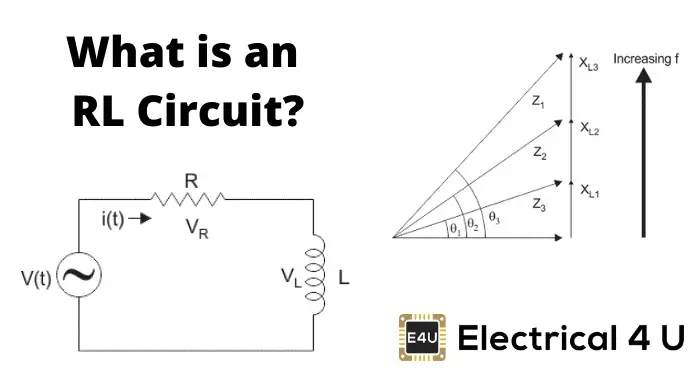
- RL Circuit Definition: An RL circuit is defined as an electrical circuit with a resistor and an inductor connected in series, driven by a voltage or current source.
- Phasor Diagram: A phasor diagram shows the phase relationships between the voltage and current in the resistor and inductor.
- Impedance: Impedance in an RL series circuit combines resistance and inductive reactance, calculated using Z = √(R² + XL²).
- Series RL Circuit Analysis: To analyze an RL circuit, calculate inductive reactance, total impedance, phase angle, and current using Ohm’s Law
- Power Factor: The power factor in an RL circuit is the ratio of true power to apparent power, indicating the efficiency of power usage.
What is an RL Circuit?
An RL network is an electrical circuit containing the passive circuit elements of a resistor R and an inductor L. This article treats their series connection under sinusoidal steady state and a DC step from a voltage source. An ideal current source can also drive an RL network, but it imposes current rather than producing the step response derived below.
The resistor converts electrical energy to heat. An ideal inductor stores energy in its magnetic field and returns it later. Similar energy accounting applies in an RC circuit or RLC circuit.
An ideal LC circuit has no average dissipation because its elements exchange stored electric and magnetic energy. Real inductors, capacitors, wires and cores introduce resistance and other losses.
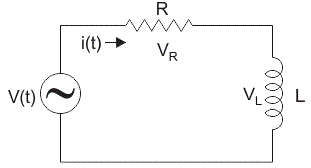
Consider an ideal resistor R and inductor L in series across a sinusoidal voltage source. The same phasor current I flows through the resistor and inductor because there is one current path. Denote the element currents by IR and IL. With ideal resistance and inductance, IR = IL = I. Let VR and Vl represent the RMS or peak voltage drop phasors, using one convention consistently.
Applying Kirchhoff voltage law in phasor form gives source voltage as the vector sum of resistor and inductor voltages, rather than their scalar arithmetic sum.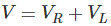
Phasor Diagram for RL Circuit
A phasor diagram of series RL circuit applies to sinusoidal steady state at one frequency. It uses the following ideal element relationships.
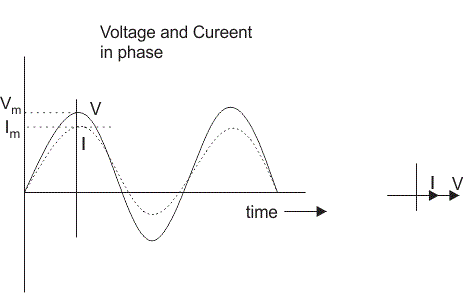
- Resistor
Voltage and current are in phase for an ideal resistor, so their phase difference is zero.
- Inductor
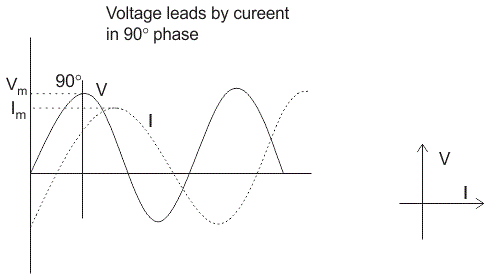
For an ideal inductor under sinusoidal steady state, voltage leads current by 90 electrical degrees. Winding resistance and core loss make a real inductor differ from this ideal relation.
- RL Circuit
Use current as the reference, then add resistor and inductor voltage phasors:
Step I. Series current is common to both elements, so IR = IL = I. Draw current I along the horizontal reference axis.
Step II. Resistor voltage is in phase with current. Draw VR on the same horizontal axis, so VR = IR.
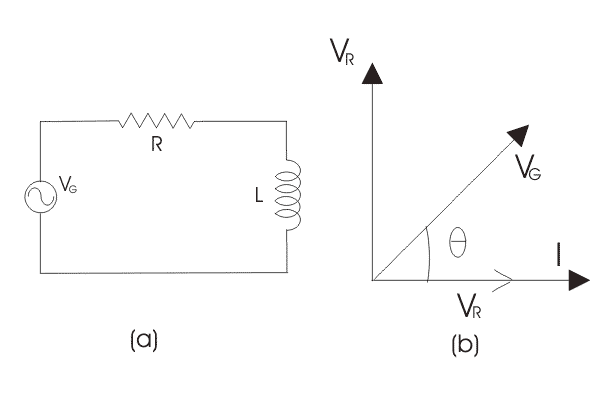
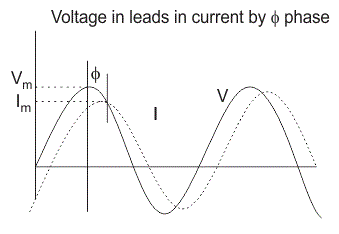
Step III. Ideal inductor voltage leads current by 90o. Draw VL perpendicular to and above the current phasor, with magnitude IXL.
Step IV. Add VR and VL vectorially. Their resultant VG is the source-voltage phasor. The right triangle gives its magnitude,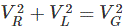 and phase angle
CONCLUSION: For positive R and L at a non-zero frequency, source voltage leads current by an angle between 0 and 90 degrees. The endpoints are ideal pure-resistor and pure-inductor limits.
Impedance of Series RL Circuit
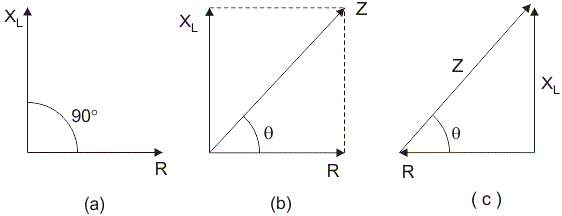
The complex impedance is Z = R + jXL, where R is the real part and inductive reactance XL = ωL is the positive imaginary part. Its magnitude in ohms is
|Z| = (R2 + XL2)0.5, and its phase angle is θ = tan– 1(XL/R) for R greater than zero.
Series RL Circuit Analysis
Given sinusoidal frequency f, source-voltage phasor V, ideal resistance R and inductance L, use complex impedance for steady-state analysis. Instruments can measure impedance, but the following calculation shows how the values relate.
Step 1. Calculate inductive reactance XL: XL = 2πfL ohms.
Step 2. Form Z = R + jXL and calculate its magnitude from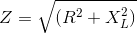
Step 3. Calculate impedance angle θ = tan – 1(XL/R).
Step 4. Apply phasor Ohm’s Law: I = V/Z. Current lags source voltage by θ.
Step 5. Calculate VR = IR and VL = jIXL. Add these voltage phasors to recover V; their magnitudes do not add arithmetically.
Power in an RL Circuit
For sinusoidal steady state, the resistor absorbs average real power while the ideal inductor exchanges reactive energy with the source and absorbs zero average power.
- Instantaneous power delivered by the voltage source is p(t) = v(t)i(t), using instantaneous quantities.
- Average resistor power is P = I2R watts when I is RMS current.
- Stored inductor energy is wL = ½Li² and varies through the AC cycle.
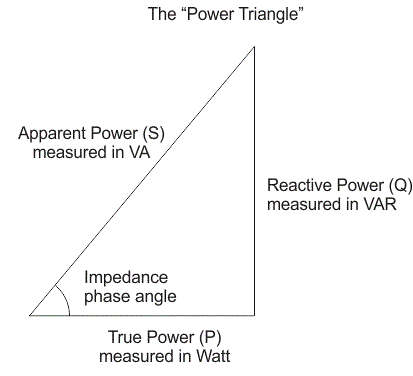

The complex power is S = P + jQ, where P = I²R and Q = I²XL for RMS current. These quantities use different units and combine vectorially; the ideal inductor’s average real power is zero.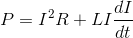
The power triangle shows P in watts, Q in vars and |S| in volt-amperes.
The electrical power factor is P/|S| = cos θ = R/|Z| for this ideal series circuit.
Variation of Impedance and Phase Angle with Frequency
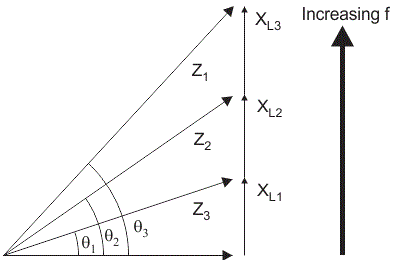
The impedance triangle has ideal resistance R on its horizontal axis and reactance XL on its vertical axis. If R and L remain constant, XL = 2πfL increases with frequency. As XL grows, magnitude |Z| and phase angle θ also increase. Real components can have frequency-dependent winding resistance, inductance, core loss and parasitic capacitance, so the simple trends apply only within the lumped ideal model.
- Inductive reactance increases in direct proportion to frequency when L is constant.
- Impedance magnitude |Z| increases when R and L remain constant.
- Phase angle θ approaches, but does not exceed, 90 degrees in the ideal model.
- Resistance is assumed constant; real AC resistance can rise with frequency.
Expression for Current flowing in Series RL Circuit
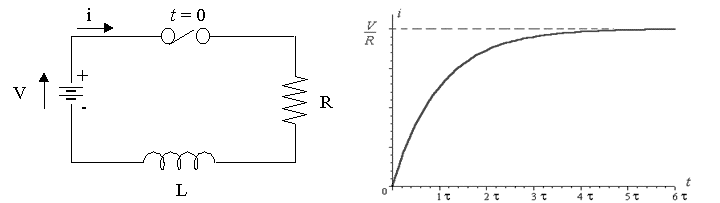
Consider an ideal inductor L and resistor R in series with a DC voltage source V. The switch closes at t = 0 with zero initial current. Inductor current cannot change instantaneously, so it rises continuously from zero towards V/R.
Kirchhoff’s voltage law gives the first-order differential equation,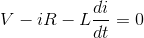
Rearrange it to separate current and time terms,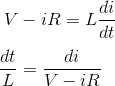
Integrate both sides from the zero-current initial condition,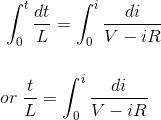
Use substitution for the current-dependent integral,
Insert the substitution values,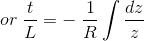
Apply the logarithmic integral,
This gives,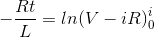
Apply the integration limits,
Simplify the logarithmic expression,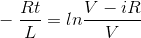
Exponentiate both sides,
Using e ln x = x gives,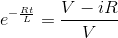
Solve for current i,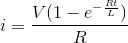
The time constant of this RL series circuit is τ = L/R. At one time constant, current reaches 1 – e⁻¹, or about 63.2%, of its final value V/R. It approaches the final value asymptotically rather than reaching it at t = τ.