

- Trigonometric Fourier Series Definition: The trigonometric Fourier series is defined as a method to represent periodic signals using sine and cosine functions, derived from the exponential form.
- Fourier Coefficients: The coefficients ak and bk determine the contribution of each sine and cosine term in the series.
- DC Component: The term a0 is the DC component, representing the average value of the signal.
- Even and Odd Functions: For even functions, bk = 0, and for odd functions, a0 = 0 and ak = 0.
- Effect of Signal Shifting: Shifting the signal horizontally changes the phase spectrum, while vertical shifts change the DC value.
We have already covered the Fourier series in its exponential form. Now, let’s explore another version: the Trigonometric Fourier series.
Fourier series representation in Trigonometric form
Fourier Series in Trigonometric Form: The trigonometric Fourier series can be derived from its exponential form. The complex exponential Fourier series for a periodic signal x(t) with a fundamental period To is given by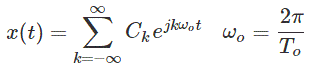
Since sine and cosine can be expressed exponentially, we can derive the trigonometric Fourier series by manipulating the exponential Fourier series.
The trigonometric Fourier series representation of a periodic signal x (t) with fundamental period T, is given by
Where ak and bk are Fourier coefficients given by
a0 is the dc component of the signal and is given by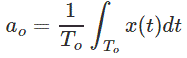
Properties of Fourier series
1. If x(t) is an even function i.e. x(- t) = x(t), then bk = 0 and
2. If x(t) is an even function i.e. x(- t) = – x(t), then a0 = 0, ak = 0 and
3. If x(t) is half symmetric function i.e. x (t) = -x(t ± T0/2), then a0 = 0, ak = bk = 0 for k even,
4. Linearity
5. Time shifting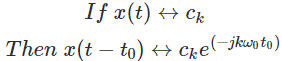
6. Time reversal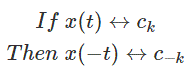
7. Multiplication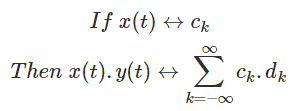
8. Conjugation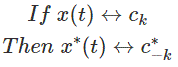
9. Differentiation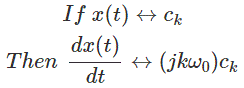
10. Integration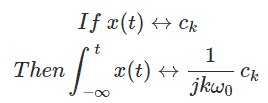
11. Periodic Convolution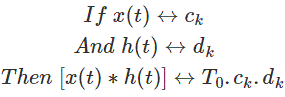
Relationship between coefficients of exponential form and coefficients of trigonometric form

When x (t) is real, then a, and b, are real, we have
Effect of Shifting Axis of the Signal
- On shifting the waveform to the left right with respect to the reference time axis t = 0 only the phase values of the spectrum changes but the magnitude spectrum remains same.
- On shifting the waveform upward or downward w.r.t time axis changes only the DC value of the function.
