

- Swinburne Test Definition: The Swinburne test of DC machine is defined as an indirect method to test the efficiency of shunt and compound wound DC machines by measuring no load losses.
- Operation Principle: This test runs the machine as a motor or generator to measure its no load losses and calculate efficiency.
- Efficiency Calculation: Efficiency is determined by subtracting the armature copper loss from the no load power input and calculating for different loads.
- Advantages: This test is convenient, economical, and allows efficiency prediction at any load.
- Disadvantages: It neglects changes in iron loss due to armature reaction, can’t assure satisfactory commutation on load, and is not suitable for DC series motors.
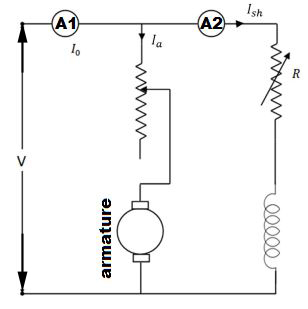
The Swinburne test is an indirect method for testing DC machines, named after Sir James Swinburne. It’s a simple and common test for shunt and compound wound DC machines with constant flux. This test pre-determines the machine’s efficiency at any load by running it as either a motor or generator and measuring no load losses separately.
The circuit setup for Swinburne’s test uses a shunt regulator to adjust the machine’s speed to the rated level. The regulator helps control the speed during the test.
Calculation of Efficiency
Let, I0 is the no load current (it can be measured by ammeter A1)
Ish is the shunt field current (it can be measured by ammeter A2)
Then, no load armature current = 
Also let, V is the supply voltage. Therefore, No load power input = VI0 watts.
In Swinburne’s test no load power input is only required to supply the losses. The losses occur in the machine mainly are:
- Iron losses in the core
- Friction and windings losses
- Armature copper loss.
Since the no load mechanical output of the machine is zero in Swinburne’s test, the no load input power is only used to supply the losses.
The value of armature copper loss = 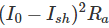
Here, Ra is the armature resistance.
To find the constant losses, subtract the armature copper loss from the no load power input.
Then, 
After calculating the no load constant losses now we can determine the efficiency at any load.
Let, I is the load current at which we have to calculate the efficiency of the machine.
Then, armature current (Ia) will be (I – Ish), when the machine is motoring.
And  , when the machine is generating.
Calculation of Efficiency When the Machine is Motoring on Load
Power input = VI
Armature copper loss, 
Constant losses, 

∴ Efficiency of the motor:
Calculation of Efficiency When the Machine is Generating on Load
Power input = VI
Armature copper loss, 
Constant losses,
∴ Efficiency of the generator:
Advantages of Swinburne’s Test
The main advantages of this test are:
- This test is very convenient and economical as it is required very less power from supply to perform the test.
- Since constant losses are known, efficiency of Swinburne’s test can be pre-determined at any load.
Disadvantages of Swinburne’s Test
The main disadvantages of this test are :
- Iron loss is neglected though there is change in iron loss from no load to full load due to armature reaction.
- We cannot be sure about the satisfactory commutation on loaded condition because the test is done on no-load.
- We can’t measure the temperature rise when the machine is loaded. Power losses can vary with the temperature.
- The Swinburne test cannot be used for DC series motors since it is a no load test.
