- Inverting Amplifier Definition: An inverting amplifier is defined as a type of operational amplifier that outputs a signal 180 degrees out of phase with the input.
- Circuit Setup: The input signal is applied to the inverting input through a resistor, while the non-inverting input is grounded.
- Voltage Gain: The gain of an inverting amplifier is the negative ratio of the feedback resistor to the input resistor, indicating phase reversal.
- Input Impedance: The input impedance of the inverting amplifier is equal to the value of the input resistor, Ri.
- Applications: Inverting amplifiers are versatile, used in everything from audio mixers to converting current signals into voltage outputs.
What is an Inverting Amplifier?
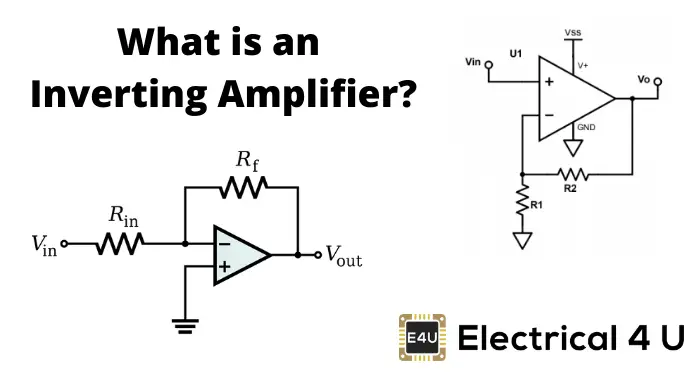
An inverting amplifier (also called an inverting operational amplifier or inverting op-amp) is an operational amplifier circuit whose output is 180o out of phase with its input.
If the input pulse is positive, the output pulse is negative, and the other way round. The figure below shows an inverting operational amplifier made from an op-amp and two resistors.
The input goes to the inverting pin through resistor Ri. The non-inverting pin is grounded. Feedback from the output to the inverting input through Rf sets the closed-loop gain.
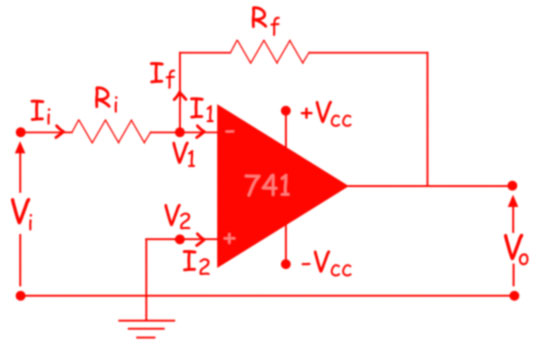
Mathematically the voltage gain offered by the circuit is given as
Where, 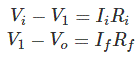
An ideal op amp is taken to have infinite input impedance, so the currents into its input pins are zero i.e. I1 = I2 = 0. Thus, Ii = If. Hence,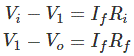
In an ideal op-amp, the voltage at the inverting and non-inverting inputs is equal.
As we have grounded the non-inverting terminal, zero voltage appears at the non – inverting terminal. That means V2 = 0. Hence, V1 = 0, also. So, we can write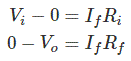
From, above two equations, we get,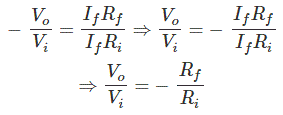
The voltage gain of the inverting operational amplifier or inverting op amp is,
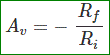
Voltage gain is the ratio of the feedback resistor to the input resistor, and the minus sign marks the phase reversal. The input impedance of the stage is Ri.
Inverting amplifiers stay linear in DC work. They convert an input current to an output voltage as transresistance or transimpedance amplifiers. They also appear in audio mixers as summing amplifiers.