
01․ The decimal equivalent of hexadecimal number of 2A0F is

02․ The binary equivalent of hexadecimal number 4F2D is
4→0100
F→1111
2→0010
D→1101
Hence, (4F2D)16 = (0100 1111 0010 1101)2
03․ To get an excess-3 code from BCD code
As name implies in excess-3 representation excess number is 3. So to get excess-3 code from BCD code we have to add 0011.
04․ Consider the following multiplication:
(10w1z) × (15)10 = (y01011001)2
Which one of the following gives appropriate values of w,y and z?
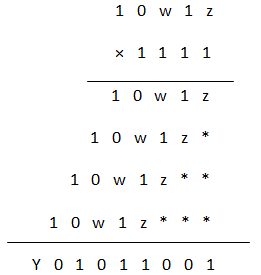 By comparing we get Z = 1, w = 1, y = 1
05․ Which of the following notations have two representations of zero?
(I) 1’s complement with radix of number being 2
(II) 7’s complement with radix of number being 8
(III) 9’s complement with radix of number being 10
(IV) 10’s complement with radix of number being 10
Select the correct answer using the codes given below:
Odd’s complement like 1’s,7’s,9’s have two representation of zero.
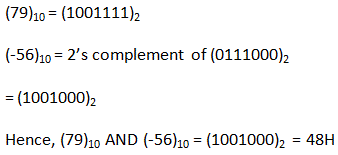
06․ AND operation of (79)10 & (-56)10 is
07․ Statement(A): 2’s complement arithmetic is preferred in digital computers.
Statement(R):The Hardware required to obtain the 2’s complement of a number is simple.
All modern computers operates based on 2’s complement as hardware is faster and simpler.
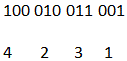
08․ A new Binary Coded Pantry (BCP) number system is proposed in which every digit of a base-5 number is represented by its corresponding 3-bit binary code. For example, the base-5 number 24 will be represented by its BCP code 010100. In this numbering system,the BCP code 100010011001 corresponds to the following number in base-5 system
09․ Which one of the following is an invalid state in 8-4-2-1 binary coded decimal counter
1100(>9) is the invalid BCD representation.
10․ The number of 1 in 8-bit representation of 127 in 2’s complement form is m and that in 1,s complement form is n. What is the value of m:n?
127→01111111
1’s complement → 10000000(n)
2’s complement → 10000001(m)
Hence, m:n = 2:1
<<<3031323334>>>