

- Kirchhoff’s Laws Definition: Kirchhoff’s laws describe how current and voltage distribute in an electrical circuit, essential for analyzing circuit behavior.
- Kirchhoff Current Law (KCL): KCL states that at any junction in an electrical circuit, the total current entering equals the total current leaving the junction.
- Kirchhoff Voltage Law (KVL): KVL states that the sum of all voltage gains and drops around any closed loop in a circuit is zero, balancing the potential differences.
- Application of Kirchhoff’s Laws: By applying KCL and KVL, we can solve for unknown currents, voltages, and resistances in complex circuits.
- Kirchhoff’s Voltage Law: This fundamental principle helps in understanding how voltage is distributed and conserved in a closed electrical loop.
Kirchhoff’s Laws
There are some simple relationships between currents and voltages of different branches of an electrical circuit. These relationships are determined by some basic laws that are known as Kirchhoff laws or more specifically Kirchhoff Current and Voltage laws. These laws are very helpful in determining the equivalent electrical resistance or impedance (in case of AC) of a complex network and the currents flowing in the various branches of the network. These laws are first derived by Guatov Robert Kirchhoff and hence these laws are also referred as Kirchhoff Laws.

Kirchhoff’s Current Law
In an electrical circuit, the curren flows rationally as electrical quantity.
As the flow of current is considered as flow of quantity, at any point in the circuit the total current enters, is exactly equal to the total current leaves the point. The point may be considered anywhere in the circuit.
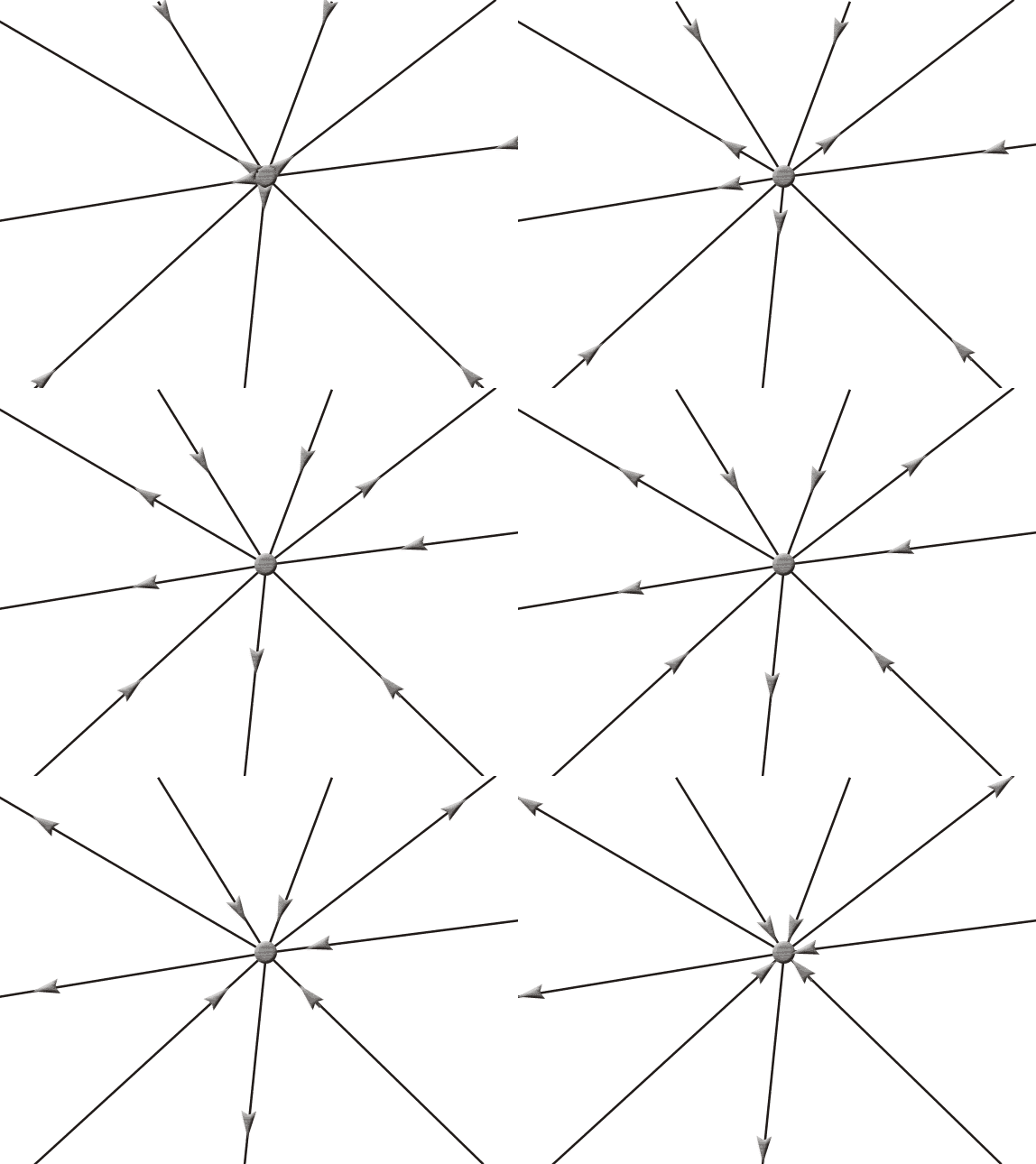
If a point is on a conductor where current flows, the current entering the point will also leave the point. This applies to any point in the circuit, including junctions.
So, total quantity of current enters at the junction point must be exactly equal to total quantity of current that leaves the junction. This is the very basic thing about flowing of current and fortunately Kirchhoff Current law says the same. The law is also known as Kirchhoff First Law and this law stated that, at any junction point in the electrical circuit, the summation of all the branch currents is zero. If we consider all the currents enter in the junction are considered as positive current, then convention of all the branch currents leaving the junction are negative. Now if we add all these positive and negative signed currents, obviously, we will get result of zero.
The mathematical form of Kirchhoff’s Current Law is as follows,
We have a junction where n number of beaches meet together.
Lets,
The currents in branches 1, 2, 3 …. m are entering to the junction.
Whereas currents in branches  are leaving from the junction.
So the currents in the branches 1, 2, 3 …. m may be considered as positive as per general convention and similarly the currents in the branches  may be considered as negative.
Hence all the branch currents in respect of the said junction are –
Now, the summation of all currents at the junction is-
This is equal to zero according to Kirchhoff Current Law.
Therefore,
The mathematical form of Kirchhoff First Law is ∑ I = 0 at any junction of electrical network.
Video Presentation of Kirchhoff’s Current Law – Basic Theory
Kirchhoff’s Voltage Law
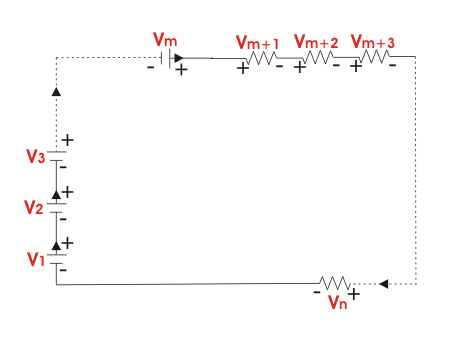
This law deals with voltage drops in various parts of a circuit. Imagine a point on a closed loop in a circuit. Moving to another point on the loop may show a different voltage. Continuing along the loop, different voltages are found at different points. Eventually, returning to the starting point shows the same voltage. This means the net voltage gain and drops in a closed loop are equal. This is Kirchhoff’s Voltage Law, also known as Kirchhoff’s Second Law.
If we consider a closed loop conventionally, if we consider all the voltage gains along the loop are positive then all the voltage drops along the loop should be considered as negative. The summation of all these voltages in a closed loop is equal to zero. Suppose n numbers of back to back connected elements form a closed loop. Among these circuit elements m number elements are voltage source and n – m number of elements drop voltage such as resistors.
The voltages of sources are 
And voltage drops across the resistors respectively, 
As it is said that the voltage gain conventionally considered as positive, and voltage drops are considered as negative, the voltages along the closed loop are –
Now according to Kirchhoff Voltage law, the summation of all these voltages results to zero.
So accordingly Kirchhoff Second Law, ∑V = 0.
Application of Kirchhoff’s Laws to Circuits
To find the current distribution in a circuit, apply Kirchhoff’s Current Law at different junctions. Then, apply Kirchhoff’s Voltage Law to each loop to create algebraic equations. Solving these equations helps find unknown currents, voltages, and resistances in the circuit.
Some Popular Conventions We Generally use During Applying KVL
- The resistive drops in a loop due to current flowing in clockwise direction must be taken as positive drops.
- The resistive drops in a loop due to current flowing in anti-clockwise direction must be taken as negative drops.
- The battery emf causing current to flow in clockwise direction in a loop is considered as positive.
- The battery emf causing current to flow in anti-clockwise direction is referred as negative.
